Particle (Basic ㊦ 166)
A sentence final particle which indicates that the preceding sentence is interrogative.
Equivalent: Whether; if
| (i) {Verb/Adjective い} | か | |
| {話す /話します} か | Will (or does) someone talk? (informal/formal) | |
| {高い /高いです} か | Is something expensive? (informal/formal) | |
| (ii) {Adjective な stem/ Noun} | {Ø/です} か | |
| {静か /静かです}か | Is something quiet? (informal/formal) | |
| {先生 /先生です} か | Is someone a teacher? (informal/formal) |
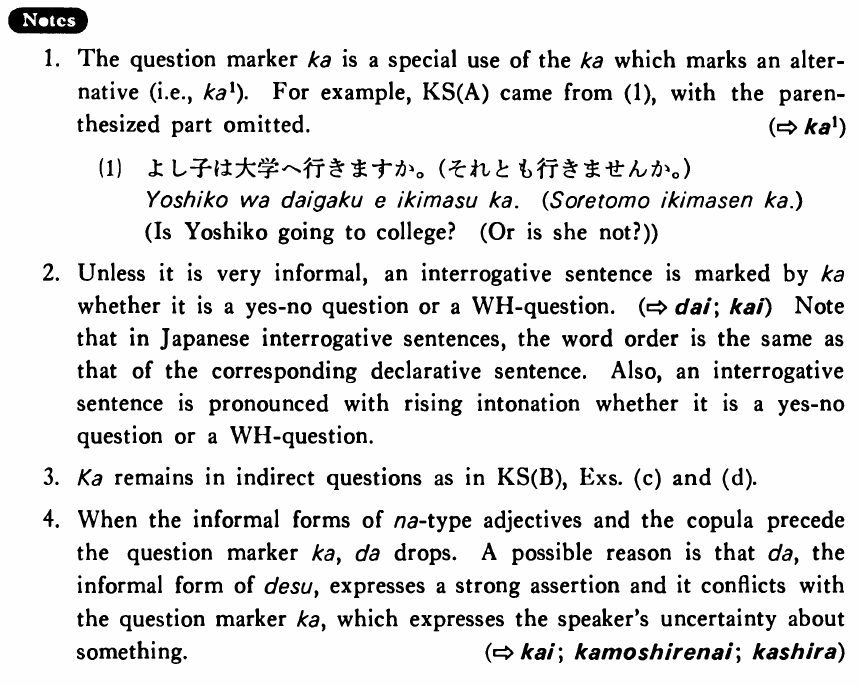
1. The question marker か is a special use of the か which marks an alternative (i.e., か1). For example, Key Sentence (A) came from (1), with the parenthesized part omitted.
(⇨ か1)
2. Unless it is very informal, an interrogative sentence is marked by か whether it is a yes-no question or an interrogative word question. (⇨ だい; かい) Note that in Japanese interrogative sentences, the word order is the same as that of the corresponding declarative sentence. Also, an interrogative sentence is pronounced with rising intonation whether it is a yes-no question or a interrogative word question.
3. か remains in indirect questions as in Key Sentence (B), Examples (c) and (d).
4. When the informal forms of な type adjectives and the copula precede the question marker か, だ drops. A possible reason is that だ, the informal form of です, expresses a strong assertion and it conflicts with the question marker か, which expresses the speaker's uncertainty about something.